 ⭐️
⭐️
SeaTunnel Engine (Zeta) Architecture
1. Overview
1.1 Problem Background
Data integration engines must solve fundamental distributed systems challenges:
- Distributed Execution: How to execute jobs across multiple machines?
- Resource Management: How to allocate and schedule tasks efficiently?
- Fault Tolerance: How to recover from worker/master failures?
- Coordination: How to synchronize distributed tasks (checkpoints, commits)?
- Scalability: How to handle increasing workloads?
1.2 Design Goals
SeaTunnel Engine (Zeta) is designed as a native execution engine with:
- Lightweight: Minimal dependencies, fast startup, low resource overhead
- High Performance: Optimized for data synchronization workloads
- Fault Tolerance: Checkpoint-based recovery with exactly-once semantics
- Resource Efficiency: Slot-based resource management with fine-grained control
- Engine Independence: Supports same connector API as Flink/Spark translations
1.3 Architecture Comparison
| Feature | SeaTunnel Zeta | Apache Flink | Apache Spark |
|---|---|---|---|
| Primary Use Case | Data sync, CDC | Stream processing | Batch + ML |
| Resource Model | Slot-based | Slot-based | Executor-based |
| State Backend | Pluggable (HDFS/S3/Local) | RocksDB/Heap | In-memory/Disk |
| Checkpoint | Distributed snapshots | Chandy-Lamport | RDD lineage |
| Operational Complexity | Lower (engine-native) | Higher | Higher |
2. Overall Architecture
2.1 Master-Worker Architecture
2.2 Job Submission, ClassLoader, and Task Dispatch Flow
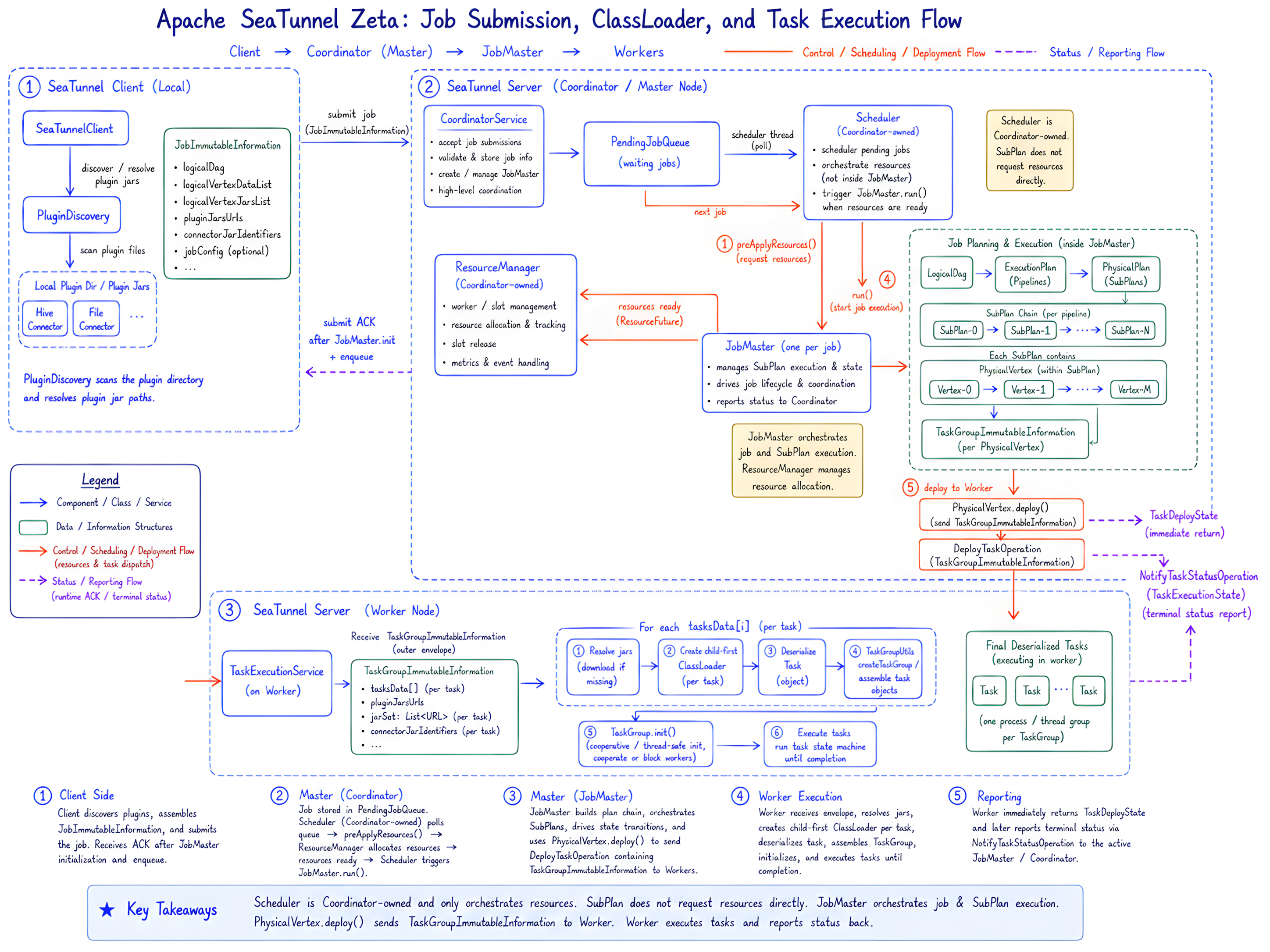
This flow fits the engine architecture section because it connects client assembly, coordinator-owned scheduling, worker-side execution, and status reporting in one view:
- The client resolves plugin jars locally and submits
JobImmutableInformation, which carries the logical DAG together with plugin jar URLs and connector jar identifiers. CoordinatorServiceaccepts the submission, records the pending job, and returns the submit acknowledgement afterJobMaster.init()and queueing are complete.- The coordinator-owned
SchedulerpollsPendingJobQueue, requests resources throughpreApplyResources(), and triggersJobMaster.run()when theResourceFutureis ready. JobMasterexpands the logical job into the pipeline-orientedExecutionPlanandPhysicalPlan, buildsTaskGroupImmutableInformation, and deploys it to workers throughPhysicalVertex.deploy()andDeployTaskOperation.- Each worker resolves missing jars, creates child-first classloaders per task, deserializes and initializes the task group inside
TaskExecutionService, executes the tasks, and reports deploy plus terminal status back toJobMasterandCoordinatorService.
2.3 Core Components
CoordinatorService
Centralized service managing all jobs in the cluster.
Responsibilities:
- Accept job submissions
- Create JobMaster for each job
- Maintain job state in distributed IMap
- Provide job query and management APIs
- Handle job lifecycle events
Key Data Structures:
// Running job state (distributed IMap backed by Hazelcast)
IMap<Long, JobInfo> runningJobInfoIMap;
IMap<Long, JobStatus> runningJobStateIMap;
IMap<Long, Long> runningJobStateTimestampsIMap;

// Completed job history
IMap<Long, JobInfo> completedJobInfoIMap;
Code Reference:
JobMaster
Manages single job execution lifecycle.
Responsibilities:
- Parse configuration → generate LogicalDag
- Generate PhysicalPlan from LogicalDag
- Request resources (slots) from ResourceManager
- Deploy tasks to workers
- Coordinate pipeline checkpoints
- Handle task failures and reschedule
Lifecycle:
Created → Initialized → Scheduled → Running → Finished / Failed / Canceled
Key Operations:
init(): Generate physical plan, create checkpoint coordinatorsrun(): Request resources, deploy tasks, start executionhandleFailure(): Restart failed tasks, restore from checkpoint
Code Reference:
ResourceManager
Manages worker resources and slot allocation.
Responsibilities:
- Track worker registration and heartbeat
- Maintain worker resource profiles (CPU, memory)
- Allocate slots based on strategies (random, slot ratio, load-based)
- Release slots after task completion
- Handle worker failures
Slot Allocation Strategies:
// 1. Random: Random selection among available workers
// 2. SlotRatio: Prefer workers with more available slots
// 3. SystemLoad: Prefer workers with lower CPU/memory usage
Code Reference:
3. DAG Execution Model
3.1 Execution Plan Transformation
3.2 LogicalDag
Represents user's intent in engine-independent way.
public class LogicalDag {
    private final Map<Long, LogicalVertex> logicalVertexMap;
    private final Set<LogicalEdge> edges;
    private final JobConfig jobConfig;
}

public class LogicalVertex {
    private final long vertexId;
    private final Action action; // SourceAction / TransformChainAction / SinkAction
    private final int parallelism;
}

public class LogicalEdge {
    private final long inputVertexId;
    private final long targetVertexId;
}
Creation:
// From user config
LogicalDag logicalDag = LogicalDagBuilder.build(jobConfig);
3.3 PhysicalPlan
Represents actual execution plan with resource allocation.
public class PhysicalPlan {
    private final List<SubPlan> pipelineList;
    private final JobImmutableInformation jobImmutableInformation;
    private final CompletableFuture<JobResult> jobEndFuture;
}

public class SubPlan {
    private final int pipelineId;
    private final List<PhysicalVertex> physicalVertexList;
    private final List<PhysicalVertex> coordinatorVertexList;
    private final CheckpointCoordinator checkpointCoordinator;
}

public class PhysicalVertex {
    private final TaskGroupLocation taskGroupLocation;
    private final TaskGroupDefaultImpl taskGroup;
    private final SlotProfile slotProfile; // Assigned slot
    private final ExecutionState currentExecutionState;
}
Generation:
PhysicalPlan physicalPlan = jobMaster.getPhysicalPlan();
// JobMaster internally:
// 1. Split LogicalDag into pipelines
// 2. Generate PhysicalVertex for each parallel instance
// 3. Create CheckpointCoordinator per pipeline
3.4 Pipeline Execution
Jobs are divided into Pipelines (SubPlans) for independent execution:
Example:
# Config with multiple sources/sinks
env { ... }

source {
  MySQL-CDC { table = "orders" }
  Kafka { topic = "events" }
}

transform {
  Sql { query = "SELECT * FROM orders JOIN events ON ..." }
}

sink {
  Elasticsearch { index = "orders" }
  JDBC { table = "events" }
}
Generated Pipelines: Generated pipelines:
Pipeline 1:MySQL-CDC → Transform → ElasticsearchPipeline 2:Kafka → Transform → JDBC
Benefits:
- Independent checkpoint coordination
- Isolated failure domains
- Parallel pipeline execution
3.5 Task Fusion
Multiple actions can be fused into single TaskGroup for efficiency:
| Mode | Runtime shape | Trade-off |
|---|---|---|
| Without fusion | Source Task → Network → Transform Task → Network → Sink Task | Clear stage separation, but more network serialization overhead |
| With fusion | TaskGroup: Source → Transform → Sink in one thread | Lower network cost and better locality, but less scheduling flexibility |
Fusion Conditions:
- Same parallelism
- Sequential dependency
- No shuffle required
4. Task Lifecycle
4.1 Task State Machine
State Transitions:
- CREATED → INIT: Task created and runtime resources initialized
- INIT → WAITING_RESTORE / READY_START: Decide between restore path and fresh start
- WAITING_RESTORE → READY_START: Restore is complete and flows are ready to open
- READY_START → STARTING → RUNNING: The task receives the start signal and enters the main processing loop
- RUNNING → PREPARE_CLOSE → CLOSED: Normal completion path after barriers and cleanup
- Active state → CANCELLING → CANCELED: External cancellation path handled outside the normal completion flow
Failure Note:
FAILEDexists as a runtime result, but task-level restart is handled by higher-level recovery logic rather than by a directFAILED → ...edge in this state machine.
4.2 SeaTunnelTask Execution
public abstract class SeaTunnelTask implements Runnable {
    private final TaskLocation taskLocation;
    private final TaskExecutionContext executionContext;
    private ExecutionState executionState;

    @Override
    public void run() {
        try {
            init();
            restoreState(); // If recovering
            open();

            while (isRunning()) {
                processData(); // Source: read, Transform: process, Sink: write
                handleBarrier(); // Checkpoint barriers
            }

            close();
        } catch (Exception e) {
            handleException(e);
        }
    }
}
Task Types:
- SourceSeaTunnelTask: Runs SourceReader, emits data
- SinkSeaTunnelTask: Runs SinkWriter, consumes data
- TransformSeaTunnelTask: Runs Transform chain
4.3 FlowLifeCycle Management
Each task manages component lifecycle through FlowLifeCycle:
// Source task
public class SourceFlowLifeCycle<T> implements FlowLifeCycle {
    private final SourceReader<T, ?> sourceReader;
    private final SeaTunnelSourceCollector collector;

    @Override
    public void open() {
        sourceReader.open();
    }

    @Override
    public void collect() {
        sourceReader.pollNext(collector); // Read data
    }

    @Override
    public void close() {
        sourceReader.close();
    }
}

// Sink task
public class SinkFlowLifeCycle<T> implements FlowLifeCycle {
    private final SinkWriter<T, ?, ?> sinkWriter;

    @Override
    public void collect() {
        T record = inputQueue.poll();
        sinkWriter.write(record); // Write data
    }
}
5. Checkpoint Coordination
5.1 CheckpointCoordinator (per Pipeline)
Each pipeline has independent checkpoint coordinator.
Responsibilities:
- Trigger checkpoint periodically
- Inject checkpoint barriers into data flow
- Collect task acknowledgements
- Persist completed checkpoints
- Clean up old checkpoints
Key Data Structures:
public class CheckpointCoordinator {
    private final CheckpointIDCounter checkpointIdCounter;
    private final Map<Long, PendingCheckpoint> pendingCheckpoints;
    private final ArrayDeque<String> completedCheckpointIds;
    private final CheckpointStorage checkpointStorage;
}
Checkpoint Flow:
- Coordinator triggers checkpoint (periodic or manual)
- Send barriers to all source tasks in pipeline
- Barriers propagate through data flow
- Each task snapshots state upon receiving barrier
- Tasks send ACK back to coordinator
- Coordinator waits for all ACKs
- Create CompletedCheckpoint, persist to storage
Code Reference:
5.2 Checkpoint Barrier
Special control message that flows with data:
public class Barrier {
    private final long checkpointId;
    private final long timestamp;
    private final CheckpointType type; // CHECKPOINT or SAVEPOINT
}
Barrier Alignment:
- Tasks with multiple inputs wait for barrier from ALL inputs before snapshotting
- Ensures consistent snapshot across distributed tasks
6. Resource Management
6.1 Slot Model
SlotProfile:
public class SlotProfile {
    private final int slotID;
    private final Address worker;
    private final ResourceProfile resourceProfile; // CPU, memory
}

public class ResourceProfile {
    private final CPU cpu;
    private final Memory heapMemory;
}
WorkerProfile:
public class WorkerProfile {
    private final Address address;
    private final ResourceProfile profile;
    private final ResourceProfile unassignedResource;
    private final SlotProfile[] assignedSlots;
    private final SlotProfile[] unassignedSlots;
    private final Map<String, String> attributes;
}
6.2 Resource Allocation Flow
6.3 Tag-Based Slot Filtering
Assign tasks to specific worker groups:
env {
  # Job-level worker attribute filter (key/value full match)
  tag_filter = {
    zone = "db-zone"
  }
}
Usage:
- Data locality (assign to workers near data source)
- Resource isolation (GPU workers for ML transforms)
- Multi-tenancy (different teams use different worker pools)
7. Failure Handling
7.1 Task Failure
Detection:
- Task reports exception to JobMaster
- JobMaster monitors task heartbeat
- Timeout triggers failure detection
Recovery:
- Mark task as FAILED
- Release task's slot
- Retrieve latest successful checkpoint
- Restart task with restored state
- Reassign splits (for Source tasks)
7.2 Worker Failure
Detection:
- ResourceManager monitors worker heartbeat
- Hazelcast cluster detects member removal
Recovery:
- Mark all tasks on failed worker as FAILED
- Trigger job failover
- Restore from latest checkpoint
- Reallocate slots on healthy workers
- Redeploy tasks
7.3 Master Failure
High Availability:
- Multiple master nodes (Hazelcast cluster)
- Job state stored in distributed IMap (replicated)
- New master takes over from IMap state
Recovery:
- Detect master failure (Hazelcast)
- Elect new master
- New master reads job state from IMap
- Reconnect to workers
- Resume checkpoint coordination
8. Design Considerations
8.1 Why Pipeline-based Execution?
Alternative: Single global DAG execution
Decision: Divide into pipelines
Benefits:
- Independent checkpoint coordination (less coordination overhead)
- Clear failure boundaries (one pipeline fails, others continue)
- Easier to reason about data flow
- Support complex DAGs (multiple sources/sinks)
Drawbacks:
- Cannot fuse tasks across pipeline boundaries
- Potential data serialization between pipelines
8.2 Why Hazelcast for Coordination?
Alternative: Zookeeper, etcd, custom Raft implementation
Decision: Hazelcast IMDG
Benefits:
- In-memory distributed data structures (low latency)
- Built-in cluster management and failure detection
- Easy to embed (no external dependencies)
- Familiar API (Java Collections)
Drawbacks:
- Memory overhead for large state
- Less battle-tested than Zookeeper for coordination
8.3 Performance Optimizations
1. Task Fusion:
- Reduce network overhead
- Improve CPU cache locality
- Lower serialization cost
2. Async Checkpoint:
- Checkpoint upload doesn't block data processing
- Parallel checkpoint across tasks
3. Incremental Checkpoint:
- Only upload changed state (future enhancement)
4. Zero-Copy Data Transfer:
- Shared memory between co-located tasks
- Avoid unnecessary serialization
9. Related Resources
10. References
Key Source Files
- Engine Core:
seatunnel-engine/seatunnel-engine-server/src/main/java/org/apache/seatunnel/engine/server/ - DAG:
seatunnel-engine/seatunnel-engine-core/src/main/java/org/apache/seatunnel/engine/core/dag/ - Checkpoint:
seatunnel-engine/seatunnel-engine-server/src/main/java/org/apache/seatunnel/engine/server/checkpoint/
Further Reading
- Hazelcast IMDG
- Google Borg Paper - Inspiration for resource management
- Apache Flink Architecture